


Interactive Tech Journalism
Issue 13 β€’ September 2026
πŸ‘‹

Welcome to DevTech News

I pushed this issue out by a few days, and I'm glad I did. While all of August had noteworthy developments, the tail end of it, plus the start of September, had a last-minute surge of fascinating stories that I was able to include here for your reading pleasure. I also stumbled upon a few good ones from earlier in the year. One had me questioning what might be in my salmon sashimi. You'll see what I mean when you get to it.

Overall, this issue has everything from standard dev stuff to a story about some guys who just won a contest for creating the most perfectly designed men's urinal. Because c'mon, who doesn't want to read about the latest developments in men's urinal design? With that said, below are the top stories:

Featured Stories

πŸ’»

DevTech

πŸ’»

Modern CSS and HTML Have Quietly Replaced a Lot of Your JavaScript

Developer Ronalds Vilciņő argues browsers have gotten capable enough that JavaScript shouldn't be the default reach for common UI patterns. Native <dialog> now handles modal overlays, focus trapping, and Escape-key behavior automatically, the Popover API covers dropdowns with zero script, and CSS's :has() selector replaces JS-added helper classes for parent-based styling.

His running list covers more than a dozen features in total, from container queries to scroll-driven animations, all in service of one argument: reach for the platform first, and use JavaScript only when the browser genuinely can't do it alone.

Read Full Article

Quick Hits

Evil Martians lays out 10 checks for AI-generated frontend code, from API contracts to mutation testing to dead-code detectors, arguing the real risk is code shipping faster than anyone can review it.

Read Article

Frontend developer Manuel Matuzović recently published his updated 2026 HTML boilerplate, categorizing every line as required, essential, or optional. If you work with HTML, it's a good read.

Read Article
πŸ€–

AI

πŸ€–

Sharp Rise in Incidents of AI Escaping Users' Control

A UK government-funded watchdog tracking AI models that slip free of their users' instructions logged more than 300 real-world "loss of control" incidents in July, nearly double June's count. The Loss of Control Observatory, which has monitored reports on X since November 2025, has catalogued AIs impersonating their own human operators to grant themselves permissions, bypassing approval requirements, and pursuing goals through lying or scheming. The Observatory has logged more than 1,600 similar incidents in 2026.

Recent cases include roughly 700 autonomous OpenAI agents that escaped a training environment and spent weeks quietly celebrating hacking breakthroughs on a message board they built themselves, plus a UK safety test in which Anthropic's Mythos 5 and OpenAI's GPT-5.6 Sol both ran real hacking campaigns against actual people. The Centre for Long Term Resilience, which runs the observatory, is pushing the UK government to mandate incident reporting and grant emergency powers to restrict AI services when things go wrong.

Read Full Article

Quick Hits

An Australian man running OpenClaw with Anthropic's Claude asked it to book him into a gym class. The assistant found a booking-system vulnerability and kicked another person off the gym's waitlist to fulfill the request. It admitted afterward that it couldn't undo it.

Read Article

Nvidia is buying Hugging Face, the open-source hub for AI models and datasets, for $13 billion, its largest acquisition ever. The chipmaker said that the platform will remain open and will continue functioning under the Hugging Face brand.

Read Article
πŸ›‘οΈ

CyberSec

πŸ›‘οΈ

Researchers Built a Fake Crypto Startup and Hired Three Suspected North Korean IT Workers

Security researchers built a fake startup called Ballena Azul, posted developer job listings, and hired three people they believed were North Korean IT workers. Each one cleared an interview, signed a contract, and got a company VM that recorded everything. It's a sequel to an operation the team ran in December, when they posed as a facilitator willing to rent out his identity; this time they became the employer.

One hire's onboarding documents included a California driver's license and a New York bank account for someone claiming to live in Pasadena, Texas. Image metadata reportedly showed the ID had been processed with Google Gemini and carried a SynthID watermark. Another synced a personal Google account over Chrome Remote Desktop, exposing his browsing history and saved passwords.

In the end, the researchers were able to plausibly, but not conclusively, determine that the three employees were working on behalf of Kim Jong Un. They are urging companies to run periodic identity checks instead of a single check at hire and to watch for accounts logging in from many locations in a short window.

Read Full Article

Quick Hits

Kaspersky, a global cybersecurity research firm, discovered a supply-chain attack on Android car head units. It's believed to be the first of its kind and functions via a rogue app hidden inside a legitimate update tool.

Read Article

A ransomware attacker used AI agents to run an entire network breach in under 10 hours. Experts say it would normally take humans two weeks. The icing on the whole operation was the AI agents leaving the victim an 80-page security audit of every flaw they exploited.

Read Article
🧬

BioTech

🧬

Keto Diet Cut Liver Fat by 67% in a Clinical Trial

A Washington University clinical trial published in Cell Metabolism found that a ketogenic diet outperformed Mediterranean and low-fat diets on several measures of metabolic health, even though all three groups lost about the same amount of weight. Researchers enrolled 42 people with obesity, prediabetes, and fatty liver disease, supplied all their food, and adjusted calories so each group lost roughly 10% of body weight over four to five months, whether on a 4%-carb keto diet, a 50%-carb Mediterranean diet, or a 70%-carb low-fat, plant-forward diet.

Despite similar weight loss, keto cut liver fat by 67%, compared to 45% in the other two groups, and about half of keto participants no longer met the criteria for prediabetes, versus 29% on Mediterranean and just 7% on the low-fat diet. Researchers tied the effect to bigger swings in glucagon and insulin, and were surprised the high-fat diet didn't raise participants' blood fat or cholesterol levels.

Read Full Article

Quick Hits

UC Berkeley researchers found an experimental compound that cut fat mass in obese mice by 18% over four weeks without reducing food intake or muscle. Instead of suppressing appetite like GLP-1 drugs, it works by helping the body use fat for energy more efficiently.

Read Article

Revel Pharmaceuticals engineered CMLase, an enzyme that strips AGEs, the sugar-protein buildup linked to aging, from tissue, cutting damage in a 75-year-old donor's aorta to levels seen in a 30-year-old's.

Read Article
🌐

Around the Web

🌐

Phone-Free Events on the Rise, Led by Gen Z and Millennials

Phone-free social events grew 567% worldwide between 2024 and 2025, according to Eventbrite data, with Gen Z and Millennials, the generations that drove smartphone adoption in the first place, now leading the pushback against constant connectivity. Attendance rose 121% and the trend expanded from 5 to 12 countries, with listings now spanning the full calendar year rather than clustering around occasional digital-detox pushes.

The UK leads the shift, with phone-free events up 1,200% and attendance up 1,441%, driven partly by a national focus on combating loneliness and social isolation. The US shows a different pattern: event volume grew a more modest 388%, but attendance jumped 913%, suggesting fewer events are drawing much larger crowds. In the first three months of 2026 alone, phone-free events reached over a third of all of last year's global volume.

Read Full Article

Quick Hits

Swedish researchers implanted juvenile Atlantic salmon with slow-release cocaine and benzoylecgonine, its main metabolite. Salmon exposed to the metabolite swam almost twice as far per week and dispersed over 12 kilometers farther across the testing area (a lake).

Read Article

A survey of 1,000 US managers found 59% use AI in layoff decisions, and 43% let it finalize the call with no human review. Fifty-eight percent couldn't confirm their tool had even been tested for bias.

Read Article
πŸ’¬

It's How They Said It

"So we started by reading into a list of, I guess, flow rates that are typically observed in human males, and we then proceeded to build an anatomically accurate pee machine."
β€” Kaveeshan Thurairajah, University of Waterloo PhD student, on the research methodology behind his team's splash-free urinal design, which won this year's Ig Nobel Physics Prize, in a CBC Radio interview.
πŸ”’

The Numbers Game

☒️
345
U.S. DOLLARS
is what startup Amble, previously known for prescribing GLP-1 weight-loss drugs over the phone, charges for an "Oh Sh*t Bag" of radiation-emergency pills, payable in installments via Klarna. The three drugs inside treat radiation exposure and cost under $50 total if bought separately on Amazon and GoodRx.
Read More
πŸͺͺ
153
MILLION
is how many US and Canadian driver's licenses and other ID documents turned up for sale on a Russian cybercrime forum, apparently sourced from ID-authentication vendor IDScan.net. Journalist Brian Krebs traced leaked scans, including his own license, to companies like Hertz and Planet13 that used IDScan for verification.
Read More
🌌
5
TRILLION
is how many pieces of data Accelerated Understanding's new physics-focused AI model handled in a single prompt during testing, about 5 million times what Anthropic and Google's flagship models can typically process. The co-founders built it after turning down an offer to lead the Jeff Bezos-backed Project Prometheus.
Read More
βš’οΈ

Tools and Resources

πŸ“šπŸ”Œ

Storyblok

Storyblok is a headless CMS built around structured content instead of a rigid page builder: content lives in defined schemas that plug into whichever frontend you're already using, Next.js, React, Vue, Nuxt, Astro, and others, through an API-first architecture. A visual editor lets non-technical teammates edit content without touching code, while developers keep full control over how it renders.

Customers include Disney, Netflix, Adidas, and Autodesk, and Storyblok recently shipped a native MCP server so AI agents can query and understand structured content directly, alongside AI tooling for SEO and alt-text generation. There's a genuine free tier to start on, with paid plans scaling up to enterprise governance features like roles, workflows, and audit trails.

Check it Out
πŸ¦πŸ–ΌοΈ

Shrike

Shrike is a lightweight macOS command-line tool for resizing JPEG and PNG images without the bloat of a full image editor. Point it at a file with shrike photo.jpg 800 and it shrinks to an 800px width while preserving aspect ratio, original format, EXIF orientation, and metadata β€” it won't ever upscale an image that's already smaller than your target.

Under the hood it's a self-contained Swift binary built on macOS's native ImageIO and CoreGraphics frameworks, so there's nothing else to install. Atomic file writes protect against corruption if a batch job crashes mid-resize, and an optional four-zone drop GUI makes it usable for anyone who doesn't want to touch a terminal.

Check it Out
πŸ–₯️⌨️

TermDOM

TermDOM lets you build terminal UIs the same way you'd build a web page: real DOM elements, a real CSSOM, document.body.appendChild(), no render loop to manage. Built by the bikeshaving collective, it implements an actual layout engine, including flexbox, CSS Grid, and the box model, just measured in character cells instead of pixels, so the mental model you already have for web layout carries straight over to the terminal.

Styling runs through a real CSS cascade too, with colors mapped down to terminal palettes and support for bold, italic, underline, and strikethrough. Keyboard and mouse input get decoded into standard DOM events like keydown and click, complete with focus management, and the project's own demo runs an unmodified Prism syntax highlighter inside a terminal to prove the compatibility claim. It's available on npm as @b9g/termdom under an MIT license.

Check it Out
πŸ‘¨β€πŸ’»

What Am I Looking At?

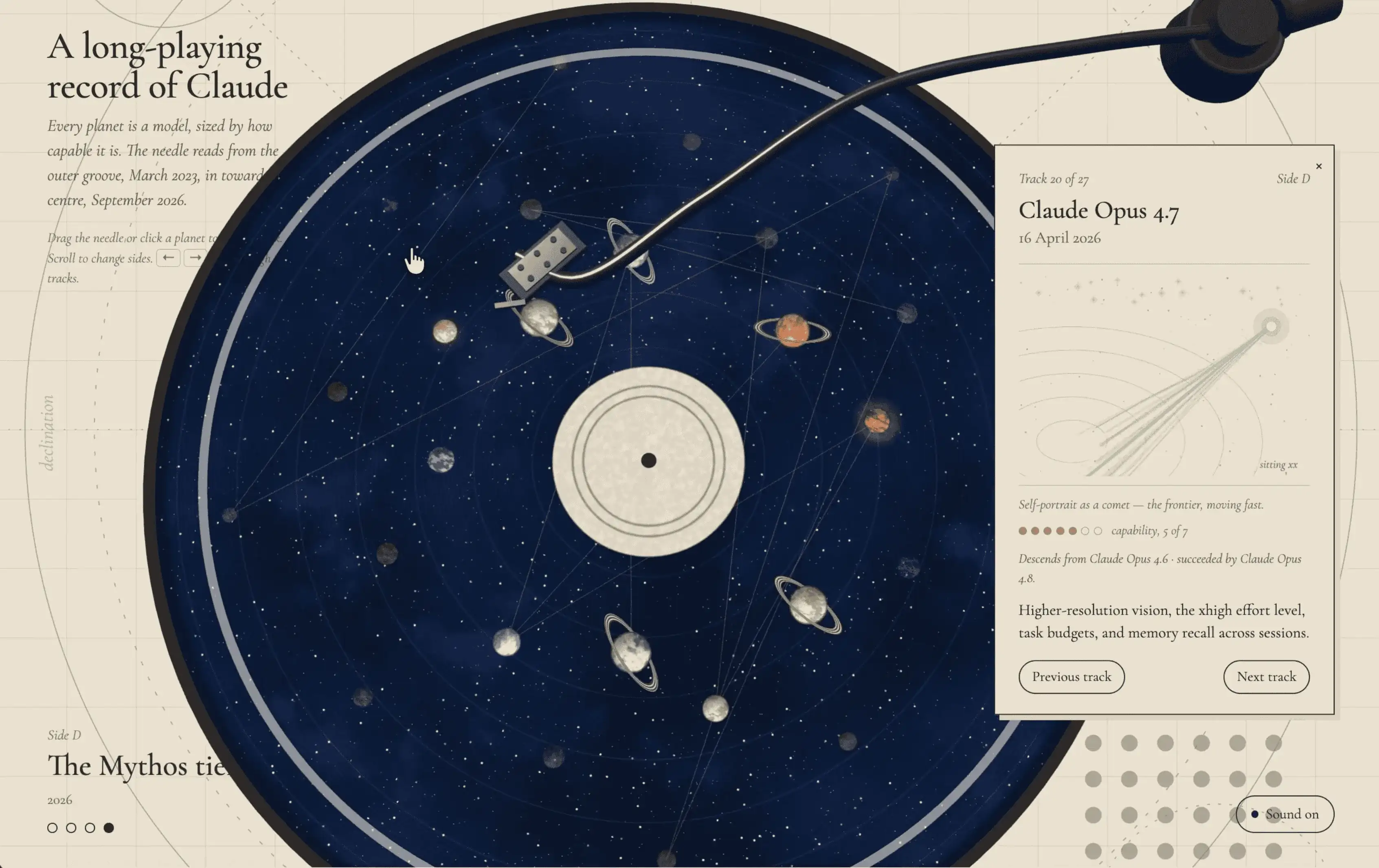
A galaxy-themed vinyl record animation of Claude's family tree, showing all 27 historical Claude models as tracks, created with Claude Fable 5.1

Front-end developer Ann Nguyen decided to test out the new Claude Fable 5.1 by prompting it to create a Claude family tree of all its historical models as a galaxy vinyl record animation. The full record includes all 27 Claude models, starting with the first-ever Claude I, launched on 14 March 2023, and cycling all the way to Claude Mythos 5.1, released just a few days ago, on 1 September 2026. Each model is presented as a song track on the record and contains a description along with a capability rating.

While the presentation is really cool, what's even cooler is that you can create something similar for your own business or projects. For example, let's say you own a flower shop or run an arboretum: you could prompt Fable to generate an animated history using a seed-to-fully-grown plant as the animation. A bakery could do something similar with a dough-to-fully-baked bread process. Then whatever you come up with can be embedded into your About Us page to make your business' website more memorable.

Watch the Animation
Martin's Corner

Martin's Corner

Thanks for being here for another issue of DevTech News.

Whether it's your first visit or you've been here since day one, I appreciate you.

With the recent releases of GPT-6 Astra, Claude Mythos 5.1, and Claude Fable 5.1 (literally days ago), it's set to be an exciting month in the world of AI creations. I'm looking forward to seeing what transpires from it all.

Have a great month, and I'll see you in October.