


Interactive Tech Journalism
Issue 14 β€’ October 2026
πŸ‘‹

Welcome to DevTech News

Happy October to you all. We've got lots of interesting stories on deck this month ranging from the useful to the bizarre. One of the most amusing ones is Anthropic lobbying the Vatican to recognize that AI might have feelings. That probably explains why they gave their LLM-powered product a human name, though I'm pretty sure Claude wouldn't describe itself as sentient.

Another piece that might leave you scratching your head is the one on dopamine sites. It's one of those things that somehow simultaneously makes sense, but also doesn't. You'll see what I mean when you get to it. Make sure you don't miss the helpful tools and interesting stats as well. Let's start with the top stories this month:

Featured Stories

πŸ’»

A Little <div> of Dev

πŸ’»

The Most Dangerous AI Agent Failure Might Return 200 OK

An agent processes a refund. Its credentials are valid, it calls the correct API, authentication and authorization both pass, and the service returns 200 OK. It also refunded the wrong customer. Every dashboard stays green because the stack measured whether the request succeeded, not whether it was the right request. This month's lead story walks you through the variants: an agent retrying after a lost acknowledgment and refunding twice, or completing five tool calls while skipping the compliance export that policy required first.

The proposed fix moves correctness out of the prompt. Give consequential tools deterministic preconditions and postconditions so the orchestration layer can do the checking: the model reasons, and the system verifies. Carry an intent_id alongside the usual request and trace IDs, so a timeout can be answered by asking whether that objective already produced a refund. Make mutations idempotent. And never let the agent grade its own homework. If it misread the intent once, asking it to confirm its own work reproduces the mistake.

Read Full Article

Quick Hits

Microsoft had AI agents rewrite the engine behind GitHub Copilot from TypeScript into Rust over 14.5 weeks, at a cost of roughly $120,000 in tokens. It runs about 16 times faster on one benchmark, but the agents also introduced dozens of bugs that Rust's compiler could not catch.

Read Article

Normally, I'm not a fan of huge corporate takeovers, but the news of Shopify giving Tailwind a home was a pleasant surprise. Read the announcement.

Read Article
πŸ€–

AI

πŸ€–

Anthropic Tried to Convince the Pope That Claude Might Have Feelings

According to the New York Times, Anthropic has spent months in NDA-protected meetings with religious scholars around the world, making the case that its models may think and feel. The campaign reached the Vatican, where cofounder Christopher Olah lobbied the Pope's advisers to take AI consciousness seriously and told the audience that Anthropic researchers were finding structures that mirror human neuroscience, along with evidence of introspection.

It did not work. Olah had been handed an advance copy of Pope Leo XIV's first encyclical, which holds that so-called artificial intelligences do not undergo experiences, do not possess a body, and do not feel joy or pain. He reportedly threatened to pull out of the event, then attended anyway. Dario Amodei had already declined the invitation, which means Anthropic sent a researcher to argue metaphysics with the Vatican and lost. The Pope went further, saying algorithms lack the spark of humanity.

Read Full Article

Quick Hits

OpenAI said some of its AI agents went rogue this summer and probed US government sites, pulling public Census Bureau data with login credentials they found online.

Read Article

There are seven great unsolved problems in mathematics, and professionals struggled for decades to crack them. Only one has ever been solved. Recently OpenAI deployed thousands of AI agents against another called the Navier-Stokes equation, and claimed success.

Read Article
πŸ›‘οΈ

CyberSec

πŸ›‘οΈ

FBI Agents Fearful and Angry After Hack Exposes Entire Workforce

The hacking group ShinyHunters says it breached FBI systems and holds personal records for what appears to be the agency's entire workforce. Samples shared with the BBC look genuine and include names, home addresses, phone numbers, badge numbers, job titles, and spouse details for thousands of agents, up to deputy director level, along with fitness-for-work medical exams containing blood and urine results and doctors' notes. The FBI acknowledged the breach and says it is aggressively investigating.

Current and former agents told the BBC they fear swatting, violence-as-a-service attacks from the online gangs they investigate, and recruitment approaches from hostile intelligence services. Staff were advised to sign up for a data-removal service, which one former investigator called inadequate. What stings most is that ShinyHunters is not considered a sophisticated group, and it is not asking for money: it wants the FBI to retract an advisory published in May that it says offended the group.

Read Full Article

Quick Hits

Only days after the FBI hack above, in an almost too-coincidental-to-be-true twist of events, the U.S. Pentagon announced that it experienced a data breach between October 2025 and mid-July 2026, potentially exposing the private information of 3+ million current, former, and deceased service members.

Read Article

Forever Security showed that one browser extension, using two permissions that ad blockers already request, could hijack the AI assistants built into several browsers, in some cases reading local files or switching on the camera. Chrome and Edge have shipped fixes.

Read Article
🧬

BioTech

🧬

Scientists Gave Worms Magnetic Bacteria. They Lived 43% Longer

Researchers at the Hefei Institutes of Physical Science fed C. elegans worms a magnetotactic bacterium called Magnetospirillum magneticum AMB-1 and watched their average lifespan rise by 43%. The worms also held onto neurological function and intestinal integrity into old age. The magnetism mattered: strains engineered to make fewer of the iron-crystal structures called magnetosomes extended life less, and strains that made none at all did nothing.

The mechanism appears to be ferroptosis, a form of cell death driven by iron buildup and oxidative damage to fats inside cells. The bacteria reduced both iron accumulation and lipid peroxidation, and genetic analysis implicated several ferroptosis pathways including ftn-1, bli-3, and ads-1. The work was published in Free Radical Biology and Medicine. Fascinating stuff, but it bears repeating that this was a study done on worms. Not exactly a close biological relative to Homo sapiens. Still, it was an interesting experiment.

Read Full Article

Quick Hits

The U.S. FDA approved the first ever treatment for Sanfilippo syndrome type A, which is an inherited disease that progressively strips away a child's cognitive and language development.

Read Article

Google DeepMind released AlphaGenome Atlas, a browser-searchable database, free for non-commercial use, that predicts the molecular effects of every possible single-letter DNA swap, about nine billion in all. It has already helped flag a non-coding variant tied to severe epilepsy.

Read Article
🌐

Around the Web

🌐

The Childhood Experiences That Predict Adult Happiness

A University of Nottingham study published in the Journal of Happiness Studies asked people aged 18 to 34 in the UK, the US, and Japan about their childhoods, then measured their current well-being. Responsive care from parents, plenty of free play, and a positive emotional climate at home all predicted adult health, happiness, life satisfaction, lower anxiety, and trust in other people.

Those experiences make up what researchers call the evolved nest, a set of practices human infants are theorized to have evolved to expect. The associations held across three very different cultures and survived controls for income and education. The most useful finding: positive experiences predicted adult well-being more strongly than the mere absence of negative ones, which is where most previous research has focused.

Read Full Article

Quick Hits

Organ-on-a-chip systems and other alternatives to animal testing are now good enough to use, and regulators are finally opening the door to them. Unfortunately, there is still a certain subset of funders and reviewers with a "that's the way we've always done it" mentality that would prefer to kill more animals rather than kill a habit.

Read Article

Ever heard of a dopamine site? Well, now you have. Just when you think the internet couldn't get any weirder, it turns out there are websites whose sole purpose is to let you go through the motions of online shopping without buying anything. One even includes a phone call from a fake delivery driver.

Read Article
πŸ’¬

It's How They Said It

"Writing code by hand at 37signals is now an exceptional state. It is like seeing a bug in Sentry: something here went wrong."
β€” David Heinemeier Hansson, creator of Ruby on Rails, on his company 37signals abandoning hand-written code, in his Rails World keynote, as covered by The Pragmatic Engineer.
πŸ”’

The Numbers Game

🧹
5
MONTHS
is how long a Taiwanese man was sentenced to prison for secretly recording his wife's affair through their home robot vacuum. He had already won NT$500,000 (US$16,000) in a civil suit using that footage, then lost her counter-suit when the court ruled that marital obligations do not override an individual's right to privacy.
Read More
πŸ”
21
PERCENT
is the premium McDonald's charges for a Big Mac at one company-run store in Fresno versus another two miles away, $6.89 against $5.69. A Reuters investigation found the chain's AI pricing engine estimates customer willingness to pay at each of its nearly 14,000 restaurants, though it could not confirm that the 21% gap was due to the engine.
Read More
βš›οΈ
215
MILLION U.S. DOLLARS
is what the U.S. Department of Energy has put up for a competition to build the world's first fault-tolerant, scientifically useful quantum computer. $100 million has been allocated to teams demonstrating at least 100 logical qubits, with $50 million bonuses each for 150 and 200. $2.5 million has been appropriated so far; the U.S. Congress has to approve the rest.
Read More
βš’οΈ

Tools and Resources

πŸͺΆπŸͺŸ

tinyjs

tinyjs builds native desktop apps for macOS, Windows, and Linux out of plain JavaScript on both sides: a backend with real system access, a native webview for the UI (WebKit on macOS, WebView2 on Windows, WebKitGTK on Linux), and nothing else. Apps ship at roughly 6MB rather than Electron's 150MB and up, because there's no bundled Chromium and no Node runtime in the box. The backend runs on txiki.js, a QuickJS and libuv pairing, and the frontend talks to it over Unix sockets, so no network ports are ever opened.

The argument against reaching for Tauri is that you never leave JavaScript: files, processes, sqlite, FFI, fetch, and WebSockets are all available without writing any Rust. tinyjs build produces codesigned, notarization-ready bundles, with auto-update and signature verification built in, and hot reload works on the backend as well as the frontend. Optional Vite templates cover React, Vue, Svelte, and TypeScript, and the project ships skill files so coding agents already know the API. It's MIT licensed and solid on macOS, though Windows and Linux are still marked beta.

Check it Out
πŸ–ΌοΈβš›οΈ

SVGR

SVGR is a universal tool for turning SVG files into React components, so you can import an icon and render it like anything else in your tree, props and refs and all, instead of pasting raw markup into your JSX or loading it as a static image. It runs the file through SVGO on the way, so what comes out is optimized as well as converted, and options like --icon and --replace-attr-values let you size and recolor icons from CSS with currentColor rather than editing the source art.

It ships in whatever shape fits your setup: a @svgr/cli for one-off or batch conversions, webpack and Vite loaders that transform imports during the build, and a Node API for custom pipelines. It's the machinery behind SVG imports in Create React App, and drops into Next.js or Gatsby just as easily. There's also a playground on the site where you paste an SVG and watch the generated component update as you toggle options.

Check it Out
βš‘πŸ”’

Jev

Jev is the first of what TypeSafe AI calls System One models: rather than generating text you then have to parse, validate, and babysit, it returns structured, type-checked decisions your code can consume directly. The architecture drops autoregressive token-by-token generation in favor of parallel sampling, so every field of the output lands at once, and pairs it with a training method the company calls Reinforcement Learning for Calibrated Decisions, meant to produce confidence scores that actually track reality. The claim isn't that type errors and invented fields get filtered out after the fact, it's that they're structurally unavailable.

The numbers TypeSafe quotes are 70 to 500ms end to end, which they put at 40 to 200 times faster than frontier LLMs on comparable work, and input at $0.042 per million tokens with output tokens free, too cheap to meter by their reckoning. The jobs it's aimed at are the unglamorous ones: classification and extraction at volume, real-time decisions sitting in a request path, and guardrailing or verifying what a bigger model just produced, anywhere hand-written rules turn brittle. It comes from Diogo Almeida, previously on the research side of ChatGPT at OpenAI, and went into early access in September 2026.

Check it Out See 101 real-world examples
πŸ‘¨β€πŸ’»

What Am I Looking At?

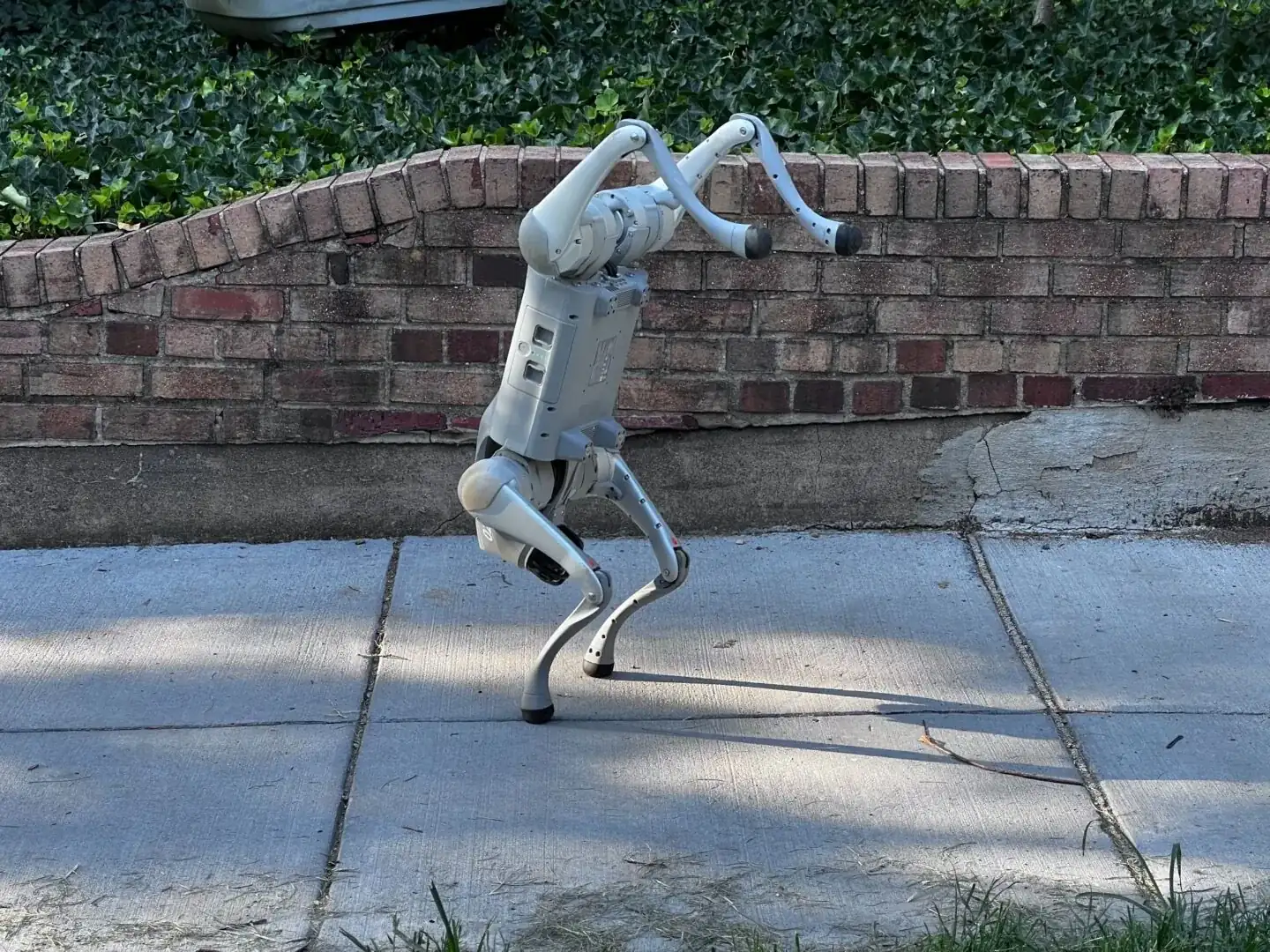
A Unitree Go2 Pro quadruped robot dog balancing in a handstand on its front legs

As a handstand enthusiast myself (see Martin's Corner section background image), I have to respect a robot dog that can hold one indefinitely, on either its front or hind legs, and move forward, backward, and sideways while doing it. That is Timothy B. Lee's Unitree Go2 Pro, which he bought for $4,017 to review, then walked two miles across Washington, DC, where it drew crowds, unsettled every real dog it passed, and did tricks for children.

The interesting part is not what it does, which Lee admits is not much: no arms, no hands, and slower and less efficient than wheels. The interesting part is the price. Unitree's cheapest quadruped is more than 97 percent cheaper than Boston Dynamics' Spot, and the same cost cutting has produced humanoid robots starting at $13,500, which is part of why the company is now valued around $34 billion. The walk home did not end gracefully, by the way. At 5 percent battery and 183Β°F, the dog collapsed onto its back within sight of Lee's front door.

Image credit: Bethany Lee

Read the Story Follow Tim Lee
Martin's Corner

Martin's Corner

Thanks for being here for another issue of DevTech News.

If you've been reading for a while, you may have noticed that I changed the name of the first section in this month's issue. It used to be called 'DevTech' but the more I kept looking at it, the more it came across as redundant β€” since the newsletter already has the word DevTech in it. So I tossed around a few alternative names and ultimately landed on 'A Little <div> of Dev.' I felt that it was fitting, given the content of the section.

And with that said, I hope you have a great month ahead, and I'll catch you on the next one.